Agents, models, and pipelines built to survive production
Graduate-level ML engineering applied to real enterprise problems — autonomous LLM agents, RAG systems, multi-agent orchestration, computer vision, classification pipelines, and Bayesian inference. Not tutorials wrapped in an API. Built from the math up.
The full ML stack, not just the LLM layer
Foundation models are one tool. The engineering challenge is knowing when to use them, when classical ML outperforms them, and how to combine both into a system that holds up under real conditions.
AI Agents & Orchestration
LLM Pipelines & RAG Systems
Classical ML & Bayesian Systems
The agentic layer: where automation stops being rigid
Traditional automation breaks when inputs change. Agentic systems reason through variation — calling tools, retrieving context, making decisions, and escalating to humans when confidence is low. We build these systems with the guardrails enterprise environments require.
Multi-agent orchestration
Marketing automation pipelines
Document intelligence
Workflow copilots
AI-powered research systems
Tool-use and API agents
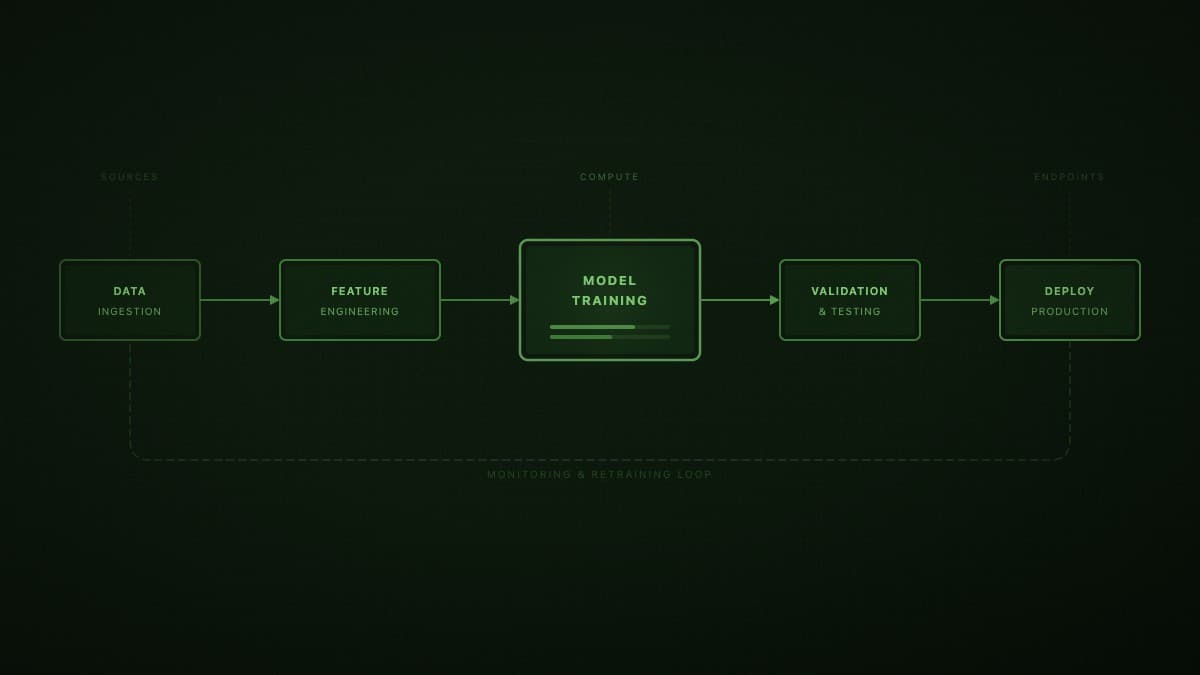
Why most AI projects don't reach production
- Evaluation frameworks that measure production behavior, not just benchmark scores
- Human review gates at decision points with non-trivial risk or consequence
- Audit logging and decision traceability designed for enterprise compliance
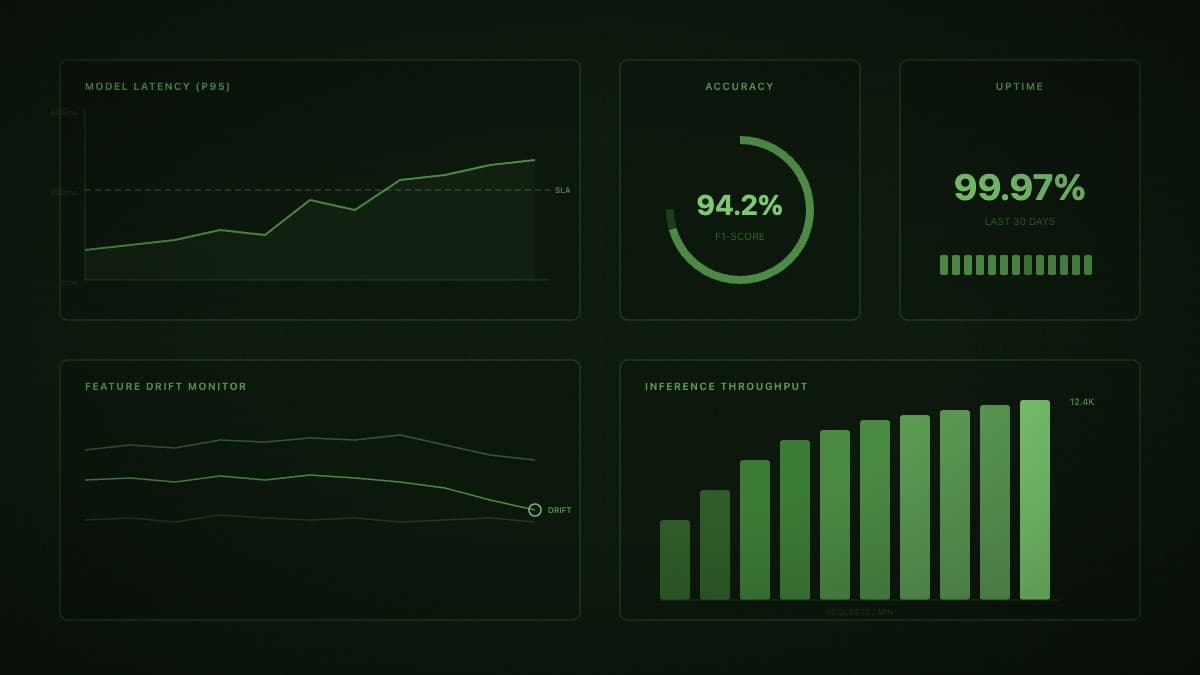
- Model drift monitoring with automated retraining pipelines where appropriate
Most AI projects fail in production — not because the model was wrong, but because no one built the infrastructure to catch when it was.
The methods that don't make headlines but do make systems work
LLMs get all the attention. The most reliable production systems combine foundation model capabilities with classical ML for precision-critical tasks where hallucination is not an acceptable failure mode.

Predictive analytics & forecasting
Computer vision pipelines
NLP for specialized domains
Clustering & segmentation
AI measured against real operational change
We benchmark against workflow speed, accuracy, and reliability — not model performance on held-out test sets that don't reflect production conditions.
Applied across domains that demand precision
The methods adapt to the domain. The standard for production reliability doesn't.