The Mallard Technologies Team ·
We’ve Entered the Intellectual Revolution
AI has proved math results that stumped people for decades. Here is what happened this year and what we think it means for intellectual work.

Over the past six months, AI systems have produced proofs of mathematical problems that the best mathematicians in the world had been working on for decades, and in some cases for more than a century. At Mallard Technologies, we work in the AI industry and have followed these results closely. What stands out to us most is how fast they're arriving.
What happened this year
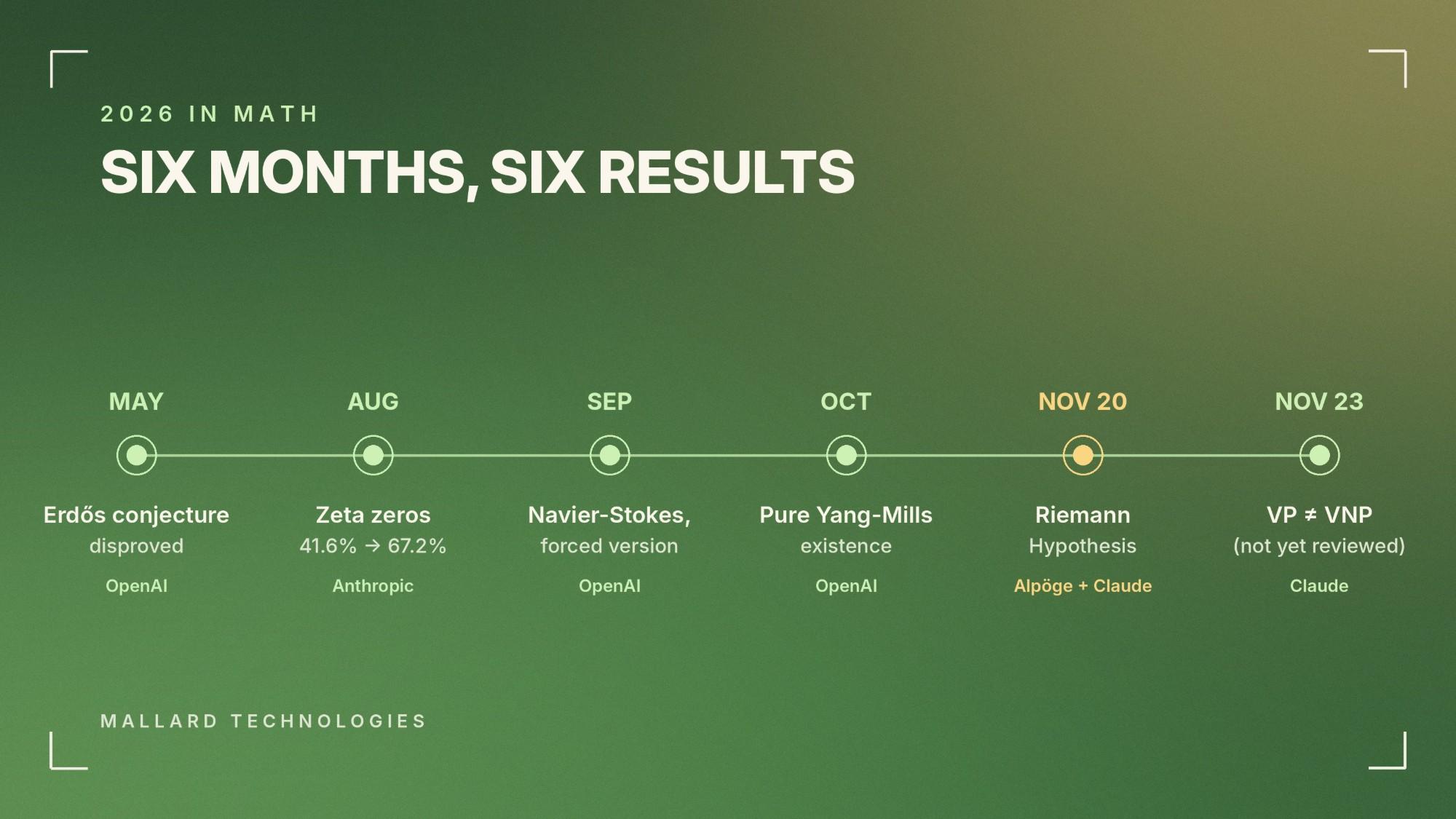
In May, an OpenAI model disproved a conjecture by Paul Erdős about unit distances. In August, Anthropic published a result where Claude raised the proven share of zeros of the Riemann zeta function on the critical line from 41.6% to 67.2%, a number that had moved by about one point in the previous 30 years. In September, OpenAI said about 10,000 AI agents had produced a proof in 88 hours that the 3D Navier-Stokes equations, which describe how fluids like water and air move, can break down when an outside force pushes the fluid. Navier-Stokes is one of the seven Millennium Prize problems, each carrying a $1 million prize.
In October, OpenAI announced a proof that pure Yang-Mills theory exists, which is half of another Millennium problem, and a committee led by Nobel laureate David Gross confirmed it in November. On November 20, Levent Alpöge, a mathematician at Anthropic, released a proof of the Riemann Hypothesis, open since 1859, that he worked out with Claude over about six weeks. Three days later, Anthropic posted a 70-page paper written entirely by Claude that claims to prove VP ≠ VNP, a 1979 conjecture closely related to the famous P vs NP problem.
Several of these cover one version or one part of a larger problem, and some are still being checked. Taken together, they represent more progress on famous open problems in six months than we would have expected in a decade.
An intellectual revolution
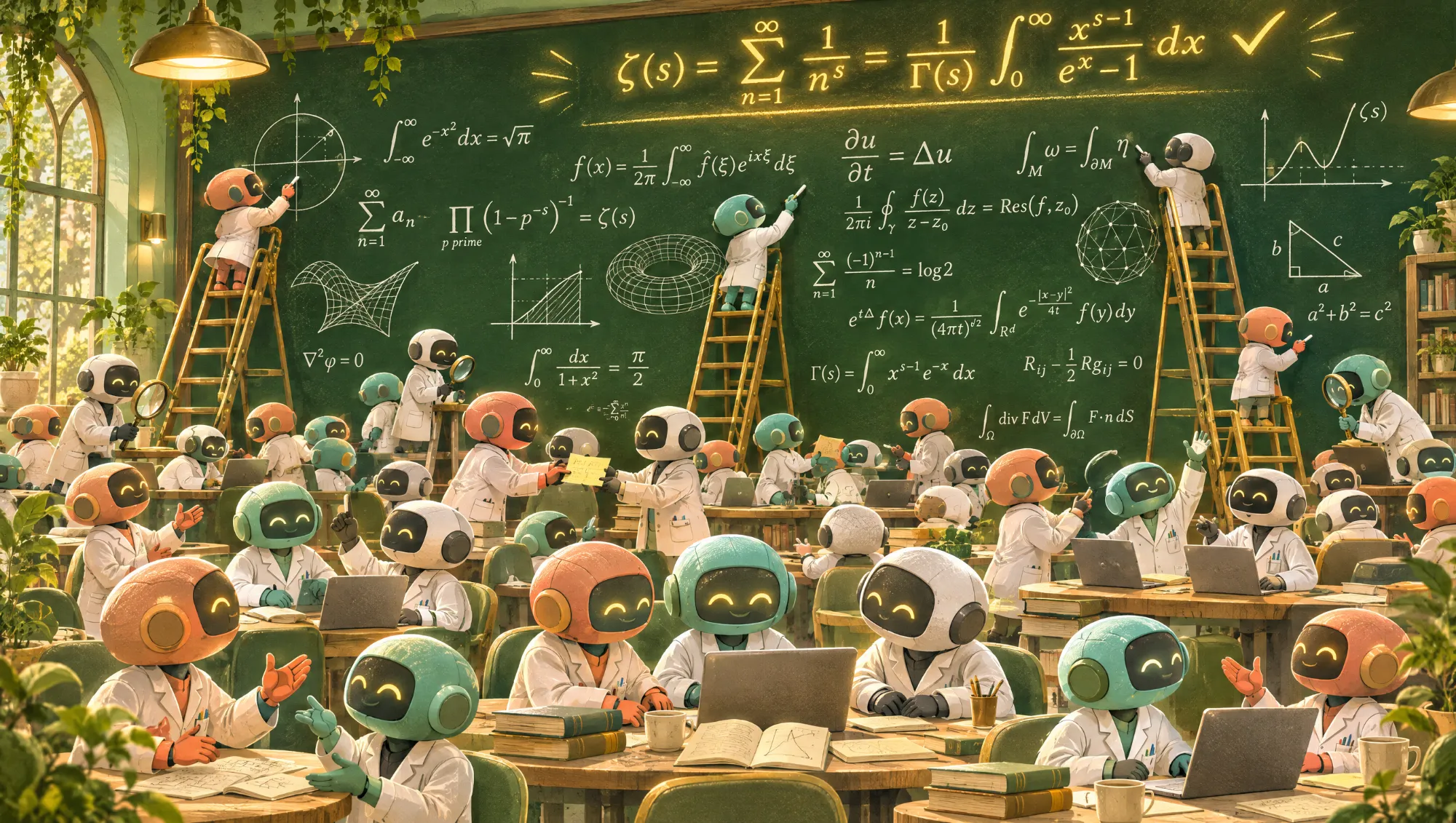
The scale behind this work is hard to picture. For Navier-Stokes, the agents exchanged roughly 2.7 million messages and produced about 130 billion tokens of output, the units AI models read and write in. Checking the result in Lean, a programming language where a computer verifies every step of a proof, took another 17 hours. That much computing costs a great deal of money, so right now this kind of work happens mostly inside AI labs like Anthropic and OpenAI. Even so, it's real, and it's happening now.
This is why we think of it as an intellectual revolution. The industrial revolution gave us machines that could do physical work at a scale no group of people could match, and output increased dramatically. The same thing is now happening to intellectual work, meaning the thinking that produces new knowledge, new mathematics and new intellectual property. In most of these cases a person still chose the problem and confirmed the result. The AI did an enormous amount of the work in between, far faster than any research group could.
Knowing before understanding
One consequence is that we're going to know some things are true before we understand why. Nobody has read all 17 million lines of the Riemann proof. A computer checked every step, and mathematicians are still writing the version people can follow. The VP ≠ VNP paper hasn't been reviewed by a mathematician at all yet.
There are two schools of thought on this. One holds that mathematics is about understanding, and that a result shouldn't be treated as settled until people can explain it from first principles. Twenty-five Fields Medal winners made that case in a letter in September. The other holds that once a computer has checked a result, research can build on it while the explanation catches up. We lean toward the second. Engineering already works this way, since nobody fully understands every line of a large codebase or what's inside a trained model. AI is also starting to help with the explaining. A demographer recently asked Claude to explain an older proof in their field and then find a simpler one, and the new proof came out shorter than the original.
What comes next
The Millennium Prize problems are hard for a reason. They have resisted the best mathematicians for decades. If swarms of AI agents can make real progress on them in a matter of days, it won't stop at math. Imagine new propulsion systems, new physics, or breakthroughs in quantum computing that came out of thousands of agents working through a problem until something held up. Imagine discovering the next calculus or the next complex numbers, a new branch of mathematics that opens up whole fields the way those did.
That's the world we're heading into. Cutting-edge research will increasingly be done by people and AI together, the same way we already rely on mathematical models and simulations, at a far larger scale. Progress won't wait for understanding to catch up, and checking the results will matter more than ever.
Sources
- AI has its own style in mathematical proving (arXiv 2611.16527): Erdős unit distance disproof and the Navier-Stokes timeline
- More than two thirds of the zeta zeros are on the critical line (arXiv 2608.13637)
- Pair Correlation of Zeros of the Riemann Zeta Function I (arXiv 2501.14545): history of the critical-line record
- AI Agent Swarms as Researchers (arXiv 2609.35719): Navier-Stokes, 10,000 agents, 88 hours, 17 hours in Lean, forced version, Millennium Prize
- From Solvers to Research (arXiv 2607.07779): 2.7 million messages, 130 billion output tokens
- King's College London: OpenAI's Navier-Stokes proof called into question
- Committee confirms OpenAI's Yang-Mills proof, mass gap open
- Riemann Hypothesis and Claude: claim, status and timeline
- Lean and Mathlib statement on the Riemann Hypothesis
- Al Jazeera: Has the world's most famous maths problem been cracked?
- DataCamp: Claude claims proof of VP vs VNP
- A Severe Misalignment of AI in Mathematics
- Can AI Do Formal Demography? (arXiv 2611.03500)
Mallard Technologies is an AI systems and custom software studio in Greater Philadelphia. We help businesses put AI agents and automation to work on real problems. If you're thinking about what that could look like for your team, get in touch or email us at info@mallardtech.com.